The Clever Connector: The Easiest Way to Become Powerful, Regardless of Your Situation. The Underdog's Guide to Networking with Billionaires, Celebrities, and Executives
Step One: Know the Power Dynamics
6,283 words
Know the Power Dynamics
Growing up, I was something of a “nice guy.” I was always treating others how I would want to be treated to the maximum capacity. As a kid, there were days in school when I would catch someone sneaking a peek at my paper during a test. Torn between a rock and a hard place, I would ask myself, “If I needed to get the right answers on a test from someone else, would I want them to help me?” The answer was yes. Sometimes I would even secretly slide my paper closer to the student cheating off my paper, so they could get a better look. I was that guy. I was raised with values that encouraged my behavior to be like this all the time.
There was a day when I was around seven years old that I had gotten forty dollars for Christmas. Later that day, while running some errands, I noticed a man from the Salvation Army ringing a bell. He had a red bucket beside a sign asking for donations. Without a second thought, I dropped all my money in the bucket—then watched in confusion as my mother shuffled through the man’s bucket to get some of the money back. I had done what I had been raised to do: treat others the way I wanted to be treated. I knew that if I were that man, possibly freezing out in the cold, working to gather donations for a noble cause, I would have wanted that forty dollar donation. So, I gave it to him. I was raised with values that encouraged my behavior to be like this all the time.
My mother never fully explained her reasoning behind taking some of the money back. It wasn’t often that I saw her contradicting the values she helped to raise me with, so I trusted her judgment and brushed it off as a “one time thing.” By brushing it off, I continued to treat others the way I wanted to be treated and carried out that value to its fullest extent.
These nice guy habits of mine almost always worked against me, but it wasn’t until I got older that I really started to notice that pattern. As I neared adulthood, I began to see that people were taking advantage of me. I maintained my kindness, because I was happy so long as I was doing what I believed was right—but as my friends started to act less like friends while still taking from me, I began to rethink the extent to which I should carry out the values I was raised with.
I could feel people distancing themselves from me and caring less about my well-being. In an effort to be more accepted in my social circles and to feel less isolated, I started cracking more jokes and developed a funnier personality. When I was around, people liked me because I was a funny guy. However, when I wasn’t around, no one seemed to care. No one checked in on me to see if I was doing okay. When I did get the chance to talk to someone over the phone, the conversation was focused on them. The funny thing about that is that a large part of me actually preferred it that way. When I wasn’t around and they didn’t reach out to me, I rationalized that it was okay because that meant more time for me to focus on my schoolwork. When we did get the chance to talk over the phone and they were talking about themselves, it was usually about some sort of drama they were experiencing in school and I saw this as an opportunity to help them. I knew that if I were in their shoes experiencing that drama and was in need of advice, I would want that help.
Then, there came a day when I was hospitalized after having my first near-death experience. I had just been diagnosed with kidney failure and had no idea what was happening to me. As I woke up from the large doses of morphine and oxycontin, my eyes opening slowly, I quickly grabbed my phone, gripping it tightly as waves of pain surged through my body. I eagerly checked if anyone had texted me but found that there were no new messages. Disappointed, I found myself in a world of confusion. I had been out of school for weeks fighting this illness. When I collapsed and was rushed to the hospital, laying on what could have easily been my death bed, I expected at least one of my friends to have reached out to me, since they had not seen me in so long. There was not one text, no missed calls, and seemingly no care at all from their side.
As grim as this experience may sound, luckily, another one of my values is not to judge someone else’s choices when you don’t understand their reasons. So, stupidly, I rationalized to myself that perhaps none of their phones were working. I remained hopeful as I scanned their social media to search for answers as to why they had forgotten to check on my well-being. Immediately, I understood. Their social media accounts were filled with pictures of them having a good time at parties and on my soccer team. I saw them enjoying themselves at the school basketball games and playing video games at their friend’s houses. The only exceptions were a couple of posts that read, “Bored. Hit me up.”
Naturally, I was angry. I had nearly died, and nobody cared.
That day, I went from being a “nice guy” to being a bully. At the time, my number one need was acceptance, and it seemed like no matter what I did, I couldn’t get it. I was already being abused at home by my family, so my friends were all I had—and now it seemed like I didn’t have them either.
In the following weeks, people began to distance themselves from me without caring if I noticed. Even good guys have bad days, but they could immediately tell something deep inside me had changed. I was willing to hurt anyone, because I didn’t care about my own life anymore.
I was hoping someone would see the emotional pain I was in and care about me for once. I was hoping someone would see the anger inside my heart and be able to empathize with me. I was hoping that the person who understood me wouldn’t judge me for who I’d become, because they’d understand how I felt inside. I was hoping that they wouldn’t judge my choices because they would understand my reasons. I was hoping that others would treat me the way I would want to be treated.
I couldn’t understand how it could be that I was a good person before and was alone, and now I was a bad person and was still alone. I had drawn the conclusion that the people I had called my “friends” were always fake, and that my sickness was all they needed to take their masks off. I was depressed, suicidal, and couldn’t have cared less about whether I lived or died.
Eventually, I had to face the fact that I didn’t have it in me to commit suicide. I wished I did because to me that would have been the equivalent of a shortcut to heaven. Back then, I felt like life was a prison. You’re not given a choice to be born in the world, but it’s illegal to try to suicide your way out. You don’t have a choice but to wake up and deal with all the cruel experiences life throws at you on a regular basis. You’re stuck here until your time comes.
It was only after I realized that I wasn’t ever actually going to commit suicide that I started to work on myself and see things a different way. I created goals for myself that forced me to improve, and I took steps outside of my unenthusiastic mindset.
I eventually started to feel like death would have been the real prison. Since I’m alive, I still have the choice to either kill myself or do something with my life. When I’m dead, there’s no choice. There’s no freedom. When you’re alive, you have the option of death—but when you’re dead, there is no option of life. That realization was the wake-up call I needed to start working harder on my goals. Luckily, my goals no longer involved death.
At the time, my ultimate goal was to make everyone feel bad for isolating me by getting rich. I knew that I needed a “socially impressive” achievement in order to gain their respect. In other words, I knew they’d care more about me if I pulled up to school in a sports car. It wasn’t the most noble reason to go after my goals, but it kept me moving forward. With a little more spring in my step, I started to research money. I needed to get closer to my goals, and I needed money to do it.
I believed money was power. Later, I was taught that there are actually three forms of power in the world: resources, information, and weaponry. We all know how money works as power, and we can all look back to the last world wars to know how weaponry works as power, but the idea that information could be a form of power was cheesy to me. It felt like an attempt to sell me the idea that “knowledge is power.” Then, I saw the examples. The way information was used as blackmail to gain power over other people. The way information was used to make more money than the next guy in the stock market.
The “knowledge is power” concept was still cheesy to me at the time, so I didn’t take it too seriously back then, but the examples were interesting. Out of curiosity, I started to dig more into the idea of power and what it really was. That was when I discovered power dynamics, and everything began to make sense.
Power dynamics, at its most simplistic, is the way in which power works in a setting. Power is the measure to which an individual can get what he wants. The word “dynamic” is synonymous with the word “process.” To that end, “power dynamics” is the process by which a person can get what he wants in a given setting.
My research of power dynamics taught me that power infuses all relationships. For example:
“In social psychology, the stereotype content model (SCM) is a model, first proposed in 2002, postulating that all group stereotypes and interpersonal impressions form along two dimensions: (1) warmth and (2) competence.”[1]1
In other words, the stereotype content model suggests that groups and individuals assess each other along two dimensions:
1. Warmth: is he friend or foe?
2. Power: how powerful is he?
“The original research refers to ‘competence’ instead of power.[2] But since ‘competence’ is defined as ‘the capacity to enact one’s intentions’[3], that’s basically also the definition of power.”
“The two axes form four quadrants. See it below with examples for each quadrant on the categories (1) politics, (2) work, and (3) relationships”[4]:
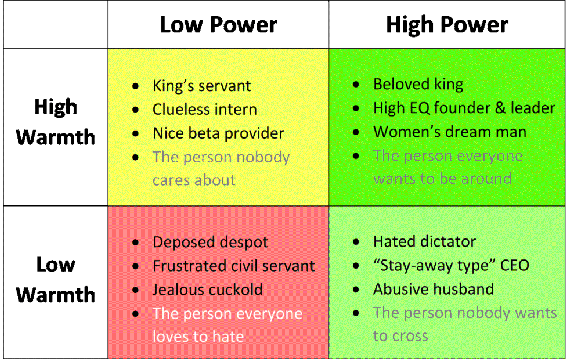
With this fascinating research, it all made sense why no one seemed to care about me. Even as a kid, I knew that if I was a multimillionaire or celebrity people would immediately start to care about me, even though I would have been a human being before and after acquiring that wealth or status.
When I was a nice guy, I had high warmth but low power. I had high warmth because I was always willing to give. But, by being willing to give everything to anyone, everyone felt like they had power over me and therefore saw me as low-power (cracking so many jokes for group acceptance didn’t help their image of my worth, either).
“For most non-powerful people, submission and high-warmth are signals to avoid confrontations. So we tend to associate very high levels of friendliness and submission with low-power.”[5] So, in my relationships, I was the person nobody cares about. The overly-friendly nice guy who finished last.
When I became frustrated and turned into a bully, I was high-power. I was capable of harming anyone with no regrets about the consequences, since I didn’t care about my own life. My aggression made me low-warmth. I became the person nobody wants to cross, and intimidated people into distancing themselves from me because of it.
Basically, I failed the social test created by the unwritten rules of social interactions. When I came to this realization, it was one of the biggest “Aha!” moments of my life.
I was able to clearly see the powerful impact of power dynamics in my social interactions (and social life as a whole). I saw, with total clarity, the conflicts between what I thought to be true based on the values I was taught as a child and the honest, true-to-life power dynamics that I was surrounded by, day in and day out.
I also learned that if your bracket changes, people also change their attitudes toward you. If you are high-power and high-warmth now, it’s unrealistic to think that if you suddenly become low-power everyone will still want to be around you. For example, if you were once a well-known celebrity but that is no longer the case, you can’t expect everyone to want a picture with you. You became low-power, so the attitudes of others changed.
Some of my high school classmates were high-warmth and considered high-power solely because they had a car, which was not common in these circles but highly desirable. One particular guy became low-power after his car broke down. People would still talk to him, but mainly to check if his car had been fixed yet. When his car was repaired, people began talking to him normally again as well as asking him for rides.
High school is a pretty judgemental environment and is different from college and the real world, so you may not run into situations as extreme as that, but the same dynamic occurs in life outside of school every day.
The highest bracket was clearly the high-warmth, high-power one in the top right. But I also understood that when you achieve that high-power and high-warmth bracket, just because everyone wants to be around you doesn’t mean it’s because everyone genuinely likes you. Your high-warmth personality and high-power success attract people like a magnet. Some of the people you attract will be haters, or even gold-diggers.
Be that as it may, that doesn’t change the “celebrity effect” high-power, high-warmth people have. That celebrity effect would open doors of opportunity that I wouldn’t be able to open in any other bracket.
As I continued my research, I saw opportunities to apply my newfound knowledge of power dynamics to the achievement of my goals. If I could become high-power and high-warmth, I could be the person everyone wants to be around. I could fix my social life.
I knew I could work on myself and become high-warmth again, but this time in a way that was more sensible, healthy, and self-respectful. I understood that I could create my own experience: if I looked and acted like an unapproachable bully, I would be treated like an unapproachable bully. So, all I had to do was to go back to liking people. Okay, cool. I can do that.
Becoming high-warmth again was easy. The real question was how to become high-power.
I concluded that I had to become high-value to become high-power. High-value means exactly what it sounds like: you have a high amount of value. You could have a high amount of value in terms of your looks, your status, your resources (lots of money and lots of powerful connections), etc. If I gained a lot of value in certain areas, I could become high-power and mix it with high-warmth to achieve the best bracket of the SCM mix. My plan was to start with acquiring value in the form of money, and then use that money to acquire status.
While that’s certainly one way to go, I drew the conclusion that this was the right course of action much too soon. I learned one simple rule that changed everything for me.
I learned that perceptions are reality[6]. To better illustrate this rule, let’s take an example. Let’s say you’re walking down the street and see a woman sitting down on a bench while waiting for her ride. You notice that she’s wearing a wedding ring on the ring finger of her left hand. Most would assume she’s married, but does that necessarily mean that’s the reality? Does her wearing a wedding ring guarantee that she’s married? There are plenty of attractive, unmarried women who wear wedding rings to keep from being approached by men throughout their day.
In another example, take the videos of millionaires “going undercover,” posing as homeless people as part of a social experiment. They were perceived as homeless people and were definitely treated like it. The perceptions became the reality, despite the truth being that they were well-off financially.
In other words, even if I only developed the traits of a high-value man, if I looked and acted the part, I would be perceived as one. This would be true even if I wasn’t actually high-value yet (in the sense that I wasn’t a billionaire). I would be what is referred to as a “high-quality man” in power dynamics.
A high-quality man is a man with the traits that directly affect their personality (in a positive way) or, more or less indirectly, allow the individual to acquire important life assets such as status, resources, mates, or friends. These are the traits of a high-quality man[7]2:
1. He is Emotionally Intelligent
- Self-awareness: one’s own emotions, drives, personality, passions
- Self-management: deferring pleasure, staying power, grit
- Social awareness: other people’s emotions and social dynamics
- Relationship management: building and managing positive relationships
2. He Has A Purpose
- A man who has a purpose is a man who has a WHY[8].
3. He Takes Care Of Himself
- Eats well
- Exercises
- Keeps learning and investing in themselves
4. He Has High Self-Esteem
- Self-esteem is different from confidence. Your level of confidence fluctuates depending on your results and skills in a given field (I could be confident in my cooking but not in drawing or painting). Self-esteem stays regardless of those external circumstances.
5. He Generates His Own Self-Esteem
- Some people depend on external forces to boost their ego and self-esteem. High-quality men have more control over their self-esteem.
6. He Has A Secure Attachment Style
- When a man has a secure attachment style he is emotionally mature. He is also comfortable being vulnerable. Vulnerability ensures that
a. He is genuine: You get to know the real him; he’s not wearing any masks
b. He is more honest: he has less need for lies because he has no need to cover his shortcomings
c. He is not abusive: he doesn’t need to “prove” his masculinity
7. He Knows Power Dynamics
- Power moves can be used for good but are commonly used to sneakily sub-communicate who’s top dog in the interaction and unfairly assert power over the other person or environment. High-quality men know power dynamics so they can understand the game being played, what’s fair and what’s not, what’s friendly and what’s rude, and what they will and will not take. He will then enforce his boundaries accordingly.
8. He Is Honest To His Own Value System
- High-quality men listen to the advice, feedback, and information of others, but ultimately they build their own value system and have their own moral compass.
9. He Has A Growth Mindset
- As explained in the introduction, people with a fixed mindset believe their qualities are set at birth and carved in stone. You are who you are, and there isn’t much you can do about it. People with a growth mindset believe they can learn and grow. They seek learning and growth opportunities because failing does not define them. On the contrary, they understand that failing is the only way they can improve.
10. He Takes Responsibility
- In other words, he has an internal locus of control. The locus of control is the degree to which people believe that they have—or don’t have—control over their life. If you have an internal locus of control, that means you believe you are in control of your life. Men with an external locus of control believe life events determine the course of their life and they don’t have control over them.
All of these traits are conducive to a man’s ability to acquire resources in life and become (and remain) high-value. These traits also impact your personality, so when you have these traits it shows. Other people see these high-quality traits and perceive you as being high-value. When people perceive you as high-value, they perceive you as high-power. If you’re high-warmth when people perceive you as high-power, you’ll be “the person everyone wants to be around” and have a much higher success rate in reaching your goals, because everyone will want to have you in their social life. “Everyone” includes powerful people. People will want to network with you, and some of those people will already be high-power themselves.
I hope I’m stating the obvious here, but a higher success rate in networking means you get higher-value connections, which increases your value since they are now one of your resources. (To put this another way, your value goes up in the eyes of others when you can name-drop millionaire, billionaire, and celebrity friends.) But it all starts with becoming a high-quality man.
This is what I didn’t understand at first. Even when I came to the realization that there were more forms of power than just money, I was missing a large part of the point. The three forms of power in the world are not information, weaponry, and money, but information, weaponry, and resources. “Resources” include money and connections.
To dive a little deeper on this point, there’s no telling what you could do with a billionaire for a dad. That’s a connection that boosts your value and your power even if you’re only connected because you’re family. That’s still a connection, and you’re therefore high-power because of it. If you’re not building your connections to grow your power and you are only focusing on money, you’re only doing a third of what you could be doing to empower yourself to achieve your goals faster and more effectively. You’re using the power of money, but forgetting the power of connections and information.
Most of us don’t have billionaires for parents, so boosting our personal power and value through gaining connections starts with boosting the way we are perceived by the people in the world that we want to connect with. Let’s go a little deeper on how this works and how you can leverage the fact that perceptions are reality.
“You choose the statement you make to the world with your attitude and appearance. When you choose that statement, you choose how the world will respond to you. If you don’t like the way people treat you, you can change that by changing the statement you make to them.”[9]
What statement are you making to the world right now, with how you carry yourself? If you act like a bully, people will treat you like a bully. If you don’t want to be treated like a bully, stop acting like one.
The same logic applies to acting like a high-value man. When first I glanced at the list of traits I would have to develop to be considered a high-quality man, I saw that I had my work cut out for me. It was at this point that I truly had to accept that life is not cured: it’s managed. I questioned why I was treated the way I was for so long, hoping the answer would bring me peace. Eventually, I had to accept that regardless of what the answer was, I wasn’t going to be able to cure my pain with only one answer, anyway. There is no cure. There is only growth.
To better illustrate this resolution, think of passion. Many people go through life hoping to find their passion by trying different things. Hoping to eventually stumble upon that one thing that makes them happy. Some even hold the belief that once you find something you are truly passionate about, you have found something that you can do everyday without ever encountering feelings of boredom or tiredness.
The reality is that your lack of passion and happiness is not “cured” by finding that one thing you’ve been missing. Passions and happiness are not found; they’re developed over time.
In that same respect, I could not be cured—I could only be developed over time. You are the manager of your life, and none of us are born good managers. Good management is an acquired skill. These “high-quality man traits” will help you acquire those skills so you can manage your life in a way that brings you a major step closer to “the good life” (health, wealth, love, and happiness).
This information is not common knowledge, so to avoid confusion understand that high-quality men and high-value men are not exactly the same. While they are similar, the two terms are not interchangeable.
However, while the terms high-quality man and high-value man are not interchangeable, in many ways, a high-quality man is a high-value man. This is because if a high-value man (a man with actual money, connections, and status) does not have any of the traits of a high-quality man, people will have a hard time perceiving him as high-value in the first place.
Imagine a scenario where, at a networking event, you notice a high-value man and a high-quality man speaking with each other. The high-quality man has good posture, his head held high, he smiles warmly, and has a very charming energy about him. He commands respect and elicits positive feelings with his very presence.
As you glance over to the high-value man, you assume he’s high-value because he’s wearing an expensive watch, but as he speaks to the high-quality man you notice that he can’t maintain eye contact. He insecurely glances down with his back hunched and arms crossed defensively. He seems unapproachable, somewhat cold blooded, and seems to be an all-around rude and disrespectful person. (You can’t imagine why this high-quality man would want to talk to someone so clearly ill-mannered and impolite.)
The nonverbal expressions (body language) of the high-quality man are ones of leadership and power. He’s clearly a dominant man as you notice his more expansive body language. The high-value man, on the other hand, submissively makes himself smaller throughout the conversation.
Now, keep in mind that perceptions are reality. If these two men are complete strangers to you, you may assume that the high-quality man is actually more successful. From the outside looking in, there is no obvious indication that the high-value man contains any traits or qualities needed to acquire resources.
People aren’t walking around with their net worth written on their foreheads, so the ones who are perceived as high-power are the ones who carry themself as if they are. Regardless of what your status or income is, if you dress, walk, talk, and act like a millionaire, people perceive you as one. Conversely, if you dress, walk, talk, and act like a homeless person, people perceive you as one. How you present yourself to people is all they will have to go by as an indicator of your success—unless you share your net worth with everyone you meet.
Now, on the other hand, even if you somehow knew the high-value man was a multimillionaire, his unlikable, unattractive, and displeasing personality gives you the knee-jerk reaction to talk with the high-quality man instead.
Since power is merely the extent to which you can attain what you want, if someone approaches the high-quality man and presents him with an opportunity, he gained an opportunity from a person due to his presentation of his traits as a high-quality man. That means he has a form of power that hard skills can’t give you: social power.
This is where “in order to ‘have’ you must ‘do’ and in order to ‘do’ you must be” comes into play. The high-value man skipped the “be” (becoming a high-quality man) and went straight into doing (making money) so he could have (the expensive watch). It’s only by deciding to “be” first that you can gain success that lasts and power that doesn’t rely on your financial situation or status. In this way, you can achieve social power and create opportunities where others can’t.
When people think of power, they only think about high-value men using their money or status to attain what they want, but high-quality men know power dynamics. They know the rules to the game of life. They understand that the world works as a system, and they leverage this system into an advantage that ethically boosts their power over everyone who doesn’t know the rules of the game.
As an analogy, we could say that you are the product. You’re selling yourself whenever you network and look to build a relationship with someone. The way you present yourself to the world is the marketing. The clothes you wear, the way you talk, walk, move, act, and carry yourself all determine whether or not people will want to buy. High-quality men market themselves as what is arguably the most valuable product in the networking world: high-value (high-power) men.
However, if people are disappointed when they buy a product, they’ll return it. In other words, if you lie about being a high-value man through unethical means—such as buying jewelry that is fake gold—when people realize you are not nearly as successful as you claim to be (when people find out who you really are) they’ll either stop wanting to connect with you or they will continue conversations with you to be polite but treat you less like an equal and more like a fan. You’ll have signaled to them that, in reality, you’re low-power. You will have also communicated to them that you are dishonest—which we could say is low-warmth, since it’s not a very kind thing to do.
Acquiring the traits of a high-quality man will increase your value and power in real ways, no different from the real effect that removing filler words from your speech pattern has on increasing your verbal influence. (People who avoid using filler words sound more like they know and believe in what they’re talking about.)
You’ll appear high-power in your social interactions, increasing your ability to attain what you want in life. When you’re high-power, you’re much harder to ignore. When you’re high-power, people feel like they can gain more from a relationship with you and become more willing to join your network.
As you become a high-quality man and better at networking, the principle of authority comes into play. “The principle of authority says we are (much) more likely to listen to someone when we perceive them as having authority.” [10] When you are a high-quality man who automatically carries himself as a high-value man, people perceive you as having authority. For comparison, in a most extreme situation, a person is more likely to listen to a high-quality man for tips on how to make money than a homeless man with low self-esteem, no purpose, and no personality who doesn’t take care of himself.
This was initially a philosophical misunderstanding for me, but it suddenly seemed more like common sense after learning about the power dynamics of my everyday interactions.
Another value I was raised with was to judge people not based on their looks, but based on the content of their character. Maybe that sounds familiar. As a kid, it didn’t make sense to me to base worth on looks, age, or success. Wisdom is wisdom. It’s not as if the wisdom of saving money is only reserved for people with a net worth of ten million dollars. There are plenty of individuals with an average income who understand how to put away ten percent of their salary each month and can share that knowledge with other people.
Wisdom can also be found in books. It’s not like books on personal finance analyze your net worth and then shut automatically with a sign popping out of the cover that says, “You’re not worthy of this wisdom.” Anyone can receive wisdom, so anyone can share it. So why judge people’s wisdom based on how they dress or how they talk? Growing up, I always thought that looks shouldn’t matter, because how good you look doesn’t affect how much you know.
However, upon learning the principle of authority, it made sense to me why people would ignore the advice of some while acknowledging the advice of others.
I watched an interview with an eight-figure millionaire interviewing a billionaire. The interview was about making money and was intended to give value to its viewers by teaching some rules and basic principles of wealth building. As I scrolled through the comments section of that video, all I saw were comments claiming that the millionaire was talking too much.
I didn’t understand how they could be so ungrateful when I could safely assume that little to none of the commenters even had one million and yet, here they were complaining that an eight figure millionaire was talking too much (giving too much advice). The comment that was repeated over and over again was that they wanted to hear more of what the billionaire had to say. The billionaire had a higher net worth, he was higher value, so he had more authority in the field of building wealth. Therefore, they wanted to listen to him more, because people want to listen to the people that they believe have more authority.
As a high-quality man, people perceive you as being high-value. When they perceive you as high-value, you gain a little authority and they are more open to listening to what you have to say. This helps you with your networking, but only if you’re willing to leverage the added power that comes with becoming a high-quality man.
In summary, there is power in information and therefore power in this book. In society, the form of power that is most respected and appreciated is resources. You can acquire resources faster by becoming a high-quality man because you’ll be perceived as a man with high power and get access to more opportunities from professionals—as long as you mix that high-power with high-warmth. With the acquisition of those resources comes success, which will grow your value and power over time—as long as you follow the rules to the game.
This strategy of becoming a high-quality man for better networking success works for women as well since the main high-quality traits for networking success are emotional intelligence and knowing power dynamics.
Some of you may be led to believe that I am overestimating the power that acquiring the traits of a high-quality man has on the way others perceive and treat you. This is understandable, since the concept of power dynamics is not very well-known and is hardly ever taught in schools. As you progress through this book, you will find further explanations and teachings as to how this process of becoming a high-quality man to achieve your goals works.
If you are already a high-quality man and currently have the power that comes with being high-warmth and high-power, but are still having trouble reaching your goals or getting to that next level, this book is also for you.
Just because everyone wants to be around you, doesn’t mean that everyone is willing to do the heavy lifting for you. Not everyone you meet will do all the relationship building for you, nor will they happily create your opportunities with no effort required on your end. The aim of this book is to fill that gap. The aim of this book is to empower you with the best information—the most effective tried-and-true networking strategies—coupled with a plan of action that will give you the ability to go out and get the opportunities you want so you don’t wind up waiting around for opportunities to come to you. Follow the program I’ve laid out in this book and by the end, you’ll wonder why you didn’t start networking sooner.
Action Steps:
1. On one piece of paper, write down all the traits and subset traits of a high-quality man
- Ex: Emotional intelligence is a trait. Self-awareness is a subset trait
2. Highlight all the traits and subset traits you currently have
- Ex: Do you workout daily? If yes, highlight the “Exercise” subset trait underneath the “He Takes Care of Himself” trait
3. On the second piece of paper, create a plan to develop each trait and subset trait you’re missing
- Replace your short-term willpower with a long-term program
- Ex: When I started out on my journey to becoming a high-quality man, I was lacking social-awareness. A part of my plan to develop that subset trait was to invest in myself with a course that teaches how to read body language and social cues.